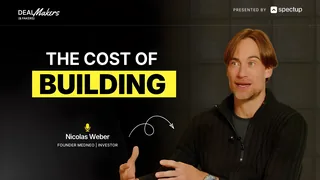
Christian Rebernik: How to Raise $15M and Build a University
Key points: Said at the table.
Who is Christian Rebernik?
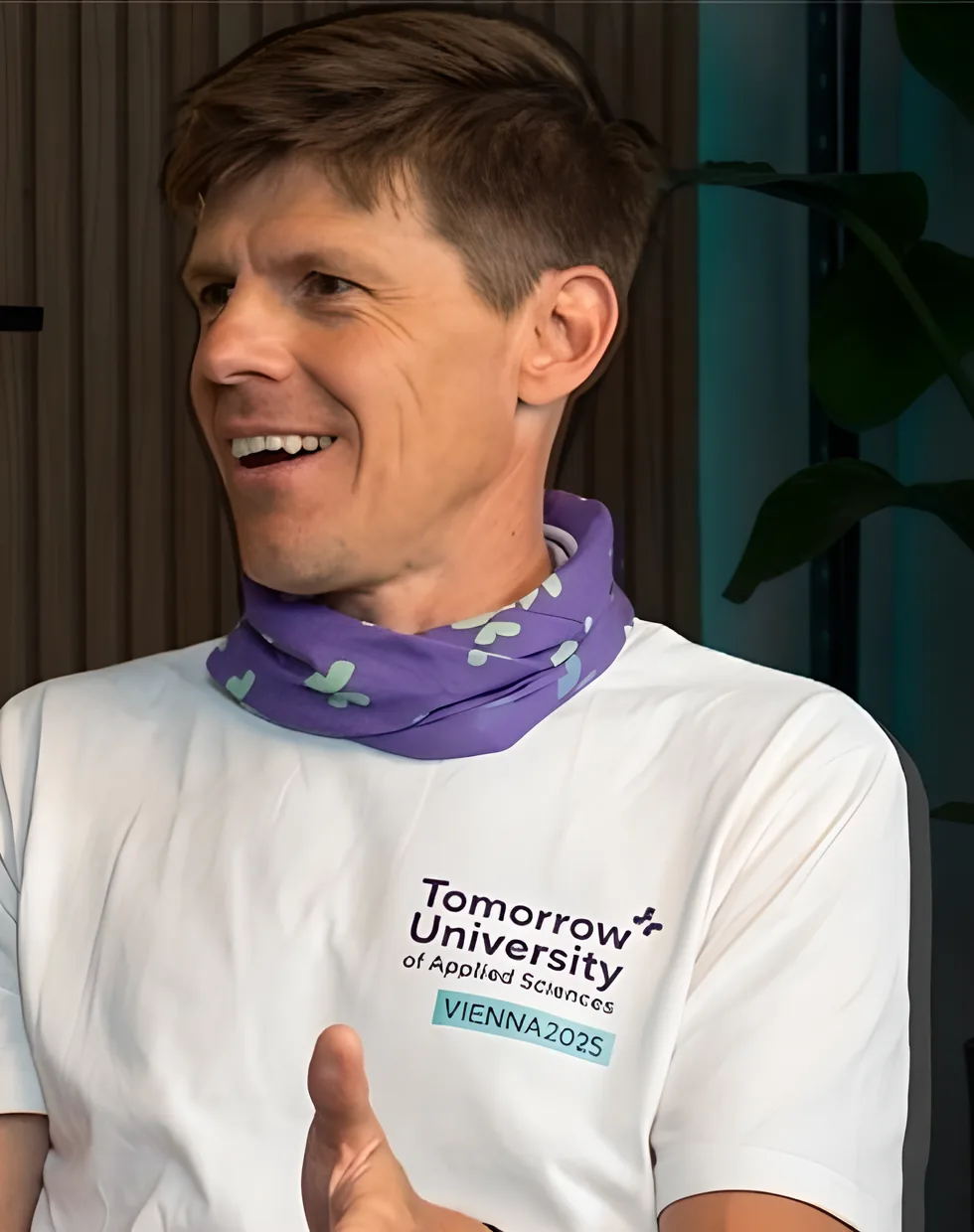
Christian Rebernik is founder and CEO of Tomorrow University, a state-recognized private university he describes as a global university for impactful careers. Before it he was CTO at N26, which he joined just after its Series A to help it become a bank. He dropped out of his first studies, saying he was never good in school.
- Series Athe round N26 had just raised when he joined as CTO6:15
- 3times a CTO, as the host puts it1:02
- 2020the year he launched Tomorrow University, in the host's introduction0:34
How to Raise a Series A: A Founder's Three Rounds
How to raise a Series A, according to Christian Rebernik, founder and CEO of Tomorrow University: find the investor first and get a warm introduction, then show in the deck that the company can monetize. Host Niclas Schlopsna puts the total Christian raised across multiple rounds at roughly 15 million US dollars.
Christian was CTO at N26, which he joined just after its Series A, having mentored its founders.
Much of what he says comes from his pre-seed and seed rounds and from investing as an angel himself, so there is no Series A-only playbook here. His Series A investors were institutions only, and the deck behind that Series A funding had to prove the company could monetize.
What did a pre-seed, seed and Series A look like for one founder?
Christian raised three rounds: pre-seed, seed and Series A. The mix of investors changed after the pre-seed:
- Pre-seed: driven mostly by angels, plus one institutional investor.
- Seed: institutional investors only.
- Series A: institutional investors only, too.
“Fundraising for me is always about relations. It's about people. And the earlier, the more it is about people.”
A pitch should still be sound, but he has not seen a successful founder whose company matched the version in his head when he started. It always changes, so early investing is more about backing the person. That is why he talked to angels who believed in him and picked different types, each helping in a field that mattered for the company.
How do you find the right investors before you raise?
Christian found his first institutional investor by reading. While researching the learning space he came across a study by Emerge Education that he felt was better than his own analysis, read every edition of the firm's blog post on it and reached out to the partner who had written it.
He decided that person was the investor he wanted before any raise. They talked a couple of times, and only much later did he ask whether the firm wanted to invest. It was a much easier decision for the investor, and Emerge became the first institutional investor in the pre-seed round.
What won him over was visible expertise: Emerge showed off its knowledge and its network. His advice to founders is to ask for advice and experience first, seek the conversation and take it further eventually, to the point where he wants to raise capital.
Juanjo Mestre, CEO and co-founder of Dcycle, built the relationships first too: for his Series A he pitched only four or five investors he had been talking to for almost a year.
He also says it is very important to get smart money, meaning the right people to support you. As an angel he would pass on a drone company, because he has no experience to leverage there, though he might invest if the founder made a very clear pitch for why he is the right fit.
How do you get an investor to take your call?
What has worked best for him is to look for the person he wants to talk to, find out who can introduce him and ask for the introduction (spectup's guide to getting warm introductions to investors covers the same step).
Sometimes he asks several people for the same introduction: an investor may ignore the first recommendation and think about the second, but the third recommendation gets the call at the latest.
- Step 1: Find the person you want to talk to
He looks for the people he wants to talk to, as with the Emerge partner he had not met before.
34:46 - Step 2: Look for who can introduce you
Then he looks for someone who can introduce him to that person.
34:58 - Step 3: Check LinkedIn for the connections
LinkedIn shows how many connections lie between you and the person. Two hubs get more complicated, but it is possible.
35:04 - Step 4: Ask several people
Sometimes he goes to several people for the same introduction. The first recommendation may be ignored, the second makes the person think about it.
35:15 - Step 5: By the third, they take the call
At the latest, the third person who tells an investor to talk to him gets the call. There is no way around it.
35:33
Christian Rebernik on Deal Makers (& Fakers), 34:46 to 35:41
A recommendation gives a much better start than cold outreach, because a cold contact has no reason to listen. Kirk Donohoe, whose startup closed a $5M pre-seed led by 20VC, makes the same call on his own episode: warm introductions are better than the cold email.
As an angel himself Christian gets a lot of requests. He recalls Florian Heinemann of Project A telling him that the firm's pitch-deck button on its website drew, as he remembers it, thousands of decks, and the number invested in was zero.
“If I get a cold email on LinkedIn or email at all, I will not even reply.”
An introduction from someone he has a personal relation with is different: he looks at it. Investors don't check a CV, he adds, they go to your LinkedIn profile, so every founder should set one up and use it.
How to raise a Series A when an investment committee decides?
Christian learned how institutions decide in his seed round, the first with institutional investors only. Convincing one partner isn't enough: there is always an investment committee in which the partners meet regularly, typically weekly or maybe every two weeks.
The founder isn't in that room. The person he talked to represents him there, and the more complex the company, the harder that job gets, because the investor has to answer the committee's questions about a business he may not know well.
Host Niclas Schlopsna adds a tip from the last investor he had on the podcast: ask how you can best prepare the investor for the weekly partner meeting. The conversation compares it to the game of telephone, where each person in the row retells the message in their own words and it gets fuzzier at every step.
How do you raise venture money for a business investors don't understand?
A university is not a typical VC case, Christian says: investors don't invest in what they don't understand, so the founder has to explain a lot.
For the seed round he opened up to generalist investors, who sit further from education than a specialist does. It was a tough process, he says, because they found the business hard to understand.
Capital was a second hurdle. As an accredited player in Germany, the university has to guarantee financially that any student who starts a three-year bachelor can finish it. From a VC perspective, he says, putting money aside for that is not very interesting.
The seed round more or less financed the accreditation, which he calls a bet that it works.
Tomorrow University has two entities: the school, and a tech company that is also the holding. He wanted a regulated entity on one side and room to innovate on the other, and says this is very similar to N26, where a large tech company sat beside the much smaller regulated N26 Bank, a setup he calls a very good blueprint.
How to raise a Series A when the pitch deck has to prove monetization?
In Christian's reading, a Series A pitch deck has to prove more than the one before it, which only showed that the team could solve the problem well. He says the most important slide is the one on the product, with the solution its most important part, and for the Series A the company also had to prove it can monetize that solution.
- What it had to showBefore the Series A: That the team can solve the problem really wellThe Series A deck: That the company can monetize the solution, with clarity and proof
- The fit behind itBefore the Series A: Problem and solution: modern pedagogy that helps people learn effectivelyThe Series A deck: Problem market fit: being able to monetize the solution
Christian Rebernik on Deal Makers (& Fakers), 41:49 to 42:22
TechCrunch analyzed his deck, which he shared with the magazine at its request. According to the host, the article said the deck read more like a manifesto than a pitch deck and that slides were missing, which the host thinks were the financials and the business model.
Christian left out slides, the financials among them, because he didn't want to disclose all KPIs, and he calls the article's complaint fair.
What he would change is to say very clearly which problems the company solves, how, and what is unique about it. His fix is to remove information so that one point gets across even better. The host adds that investors also have to bring the deck back to the other investors.
When is the right time to raise a Series A?
“I always say the worst time to raise capital is when you need capital.”
Many founders get it wrong because they start the raising process when they need the money, he says, and the host adds that it makes them look desperate: a psychology game in which the less desperate, the better.
On when to raise capital, he describes a graph that looks a little like stairs: valuation rises in steps, each step a proof point you've reached, such as a revenue threshold, a certain hire or product-market fit. When a step has just happened, that is when you could consider raising, and not when you need money.
- What sets the timingWhen you need the money: The need for capitalAfter a proof point: A step up: a revenue threshold, a hire, product-market fit
- How it playsWhen you need the money: You can end up in a position where you are, or look, desperate: a psychology gameAfter a proof point: A step has just happened, which is when you could consider fundraising
Christian Rebernik and Niclas Schlopsna on Deal Makers (& Fakers), 58:37 to 59:42
Nick Kanopoulos, founder and CEO of Brite Solar, had a different trigger: he raised Series A funding because he needed money to build a factory that his operations could not pay for.
What should a founder learn about a term sheet before signing?
If Christian could give founders one piece of advice, it would be that the details of the term sheet matter: when the money closes it's tempting to think only the money counts, but if the company succeeds, the terms matter so much.
The one detail he gets specific about is control. He points to Elon Musk's control of SpaceX, from a biography he has just read, and says control makes a huge difference for a founder. It is a topic he often got wrong himself, and it is never too early, he says, to make clear that shares do not all carry the same voting rights.
He declined investors over terms, but thinks he could have made much better choices about his own, and says it's also a question of power dynamics. He says he could tell many stories of terms that went wrong for founders. He recommends getting educated on term sheets, including what each term means over the medium to long term, because in his view founders are undereducated on terms.
For a founder planning how to raise a Series A, the takeaway is to read the term sheet for what each term means over the medium to long term.
Asked and answered.
5 questions this conversation answers, in plain words.
Christian doesn't define the stages; his own three rounds show one path. The pre-seed was driven mostly by angels plus one institutional investor. The seed investors were institutions only, and so were the Series A investors. He says fundraising is always about relations: the earlier the round, the more it is about people.
Christian Rebernik says to ask for advice and experience first, seek the conversation and take it further eventually, to the point where you want to raise capital. He also calls smart money, meaning the right people to support you, very important. Reach investors through other people: a recommendation gives a much better start than cold outreach, because a cold contact has no reason to listen.
Yes, Christian says: investors don't check a CV, they go to your LinkedIn profile to research you. He once invested in a founder with none and found it awkward, though some professions, such as doctors, are not on LinkedIn.
It depends on the VC, Christian says. There are specialists for most sectors, generalists that invest independent of the industry, regional funds and funds that back only second-time founders. For his seed round he opened up to generalists, further from education, and it was a tough process.
That the company can monetize its solution, with clarity and proof, Christian says. The decks before only had to show that the team could solve the problem well, with modern pedagogy that helps people learn effectively. For the Series A he also had to show problem market fit: that the company is able to monetize the solution.
Follow Christian, or keep listening.
Four ways to keep going once the episode ends.
- The guestSee what Tomorrow University is today
The state-recognized private university Christian built after leaving N26.
Visit Tomorrow University - FollowFollow Christian on LinkedIn
Christian is founder and CEO of Tomorrow University and was CTO at N26 before it.
Open his LinkedIn profile - Keep listeningWarm introduction or cold email?
Kirk Donohoe on how he raised $5M from 20VC, and why he put the warm introduction first.
Listen to Kirk Donohoe - The showFollow Deal Makers (& Fakers)
New episodes with founders and investors on how deals really get done.
Follow on Spotify